
Whether a small anterior pannus disqualifies a hEDS patient from PICL is one of the more consequential open questions in craniocervical care right now. The answer is being worked out one case at a time, and patients deserve to see how that conversation actually goes.
Craniocervical instability (CCI) is a condition where treatment decisions are unusually individual. The two main paths — Percutaneous Implantation of the Cervical Ligaments (PICL) versus surgical stabilization — are not interchangeable, and the criteria for choosing between them are still being refined in real time.
One of the questions driving that refinement: does the presence of an anterior pannus — a thickening of soft tissue that can contribute to anterior or posterior compression — rule a patient out of PICL?
Dr. Chris Centeno, Dr. Rowan Paul, and Dr. Fraser Henderson are the three voices I keep coming back to on this. Patient selection criteria for PICL are still evolving. This post walks through:
- What anterior pannus actually means in CCI treatment planning
- What Centeno’s PICL randomized controlled trial does and does not show
- Where motion-preserving CCI surgery has moved
- The questions patients and providers should be asking before committing to either path
For broader context on hEDS and MCAS management, start here and here.
Why anterior pannus is the right question
CCI evaluation requires looking at structures that don’t show clearly on a single static MRI. Regenerative approaches like PICL have shown promise. Surgical approaches have advanced — skull-fusion-sparing techniques in particular. The two paths are no longer either-or, and the decision is getting more nuanced rather than less.
As a patient advocate, I work closely with leading physicians in both regenerative and surgical CCI care. The goal of this post is to make the evidence and the open questions visible to patients and providers who are trying to make this decision in real time.
Case study: Sarah (name changed)
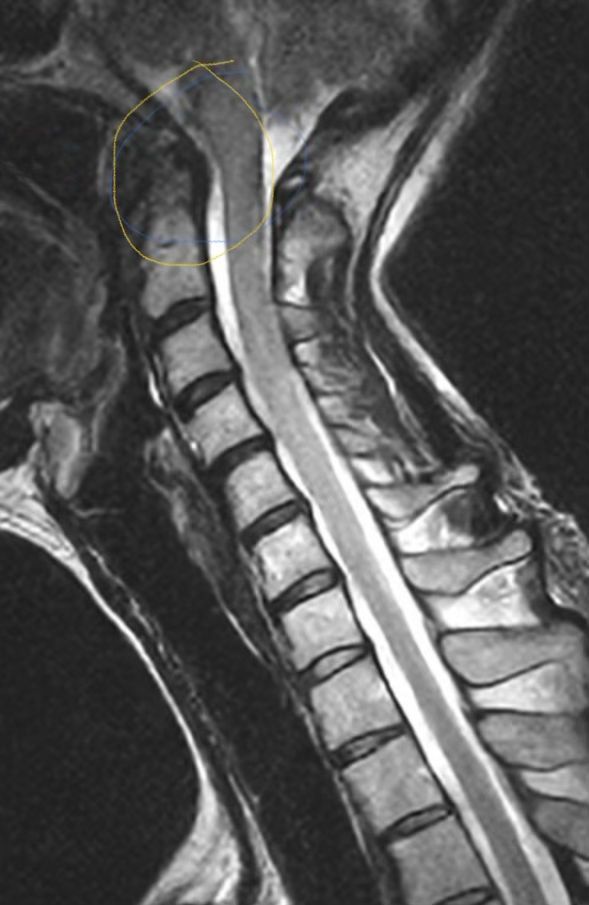
Sarah has documented craniocervical instability and a history of juvenile rheumatoid arthritis (JRA). She has consulted multiple specialists, and the imaging interpretations did not converge:
- Three physicians flagged an anterior pannus with both anterior and posterior compression on her scans.*
- Dr. Chris Centeno, who has been tracking response patterns at scale, did not flag the anterior pannus in his assessment.
- Dr. Rowan Paul reviewed the case carefully but did not call it a definitive contraindication — recognizing the complexity of the decision.
- Another provider raised the concern that an anterior injection could swell the pannus and worsen compression.
- Sarah has since transferred DOs and is choosing between PICL and surgery with a nationally regarded provider specializing in motion-preserving techniques, whom she will consult shortly.
- Dr. Fraser Henderson, who pioneered skull-fusion-sparing CCI surgery at Metropolitan Neurosurgery, has reviewed her records and consulted but has not examined her in person.
Sarah understands that PICL may be a useful step regardless of whether she ultimately needs surgical stabilization — and that, if she is a candidate, it may improve her long-term outcome either way.
The central question her case raises: should an anterior pannus be considered a contraindication for PICL? There is no universal consensus. Ongoing case tracking is how we will get to one.
What the PICL RCT does and does not say
Centeno’s PICL randomized controlled trial reports that 70% of patients who received PICL did not proceed to surgical intervention. That number is meaningful, but it has to be read in context:
- Time frame. The duration over which the 70% figure is measured is not explicitly defined in the public summaries I have seen.
- Inclusion criteria. The trial’s patient selection was tight. Real-world application to a more heterogeneous population will vary.
- Contraindications are still being defined. The role of anterior pannus in PICL candidacy is exactly the kind of question the field is still actively working through.
- Injection technique matters. Not all approaches to injecting the alar ligament have equivalent safety profiles. I am aware of at least one provider whose process may be less safe under these conditions. The safety of one injector and one method does not generalize to all injectors and all methods.
- Surgical pathways for unstable cases. Visible vertebral slippage on static imaging may indicate a need for more robust stabilization, which favors surgery over regenerative work in those specific cases.
For patients and referring physicians: PICL is at the cutting edge of regenerative medicine. Patient education should reflect that PICL is not only a standalone procedure — it can also serve as a step before less invasive surgical options, including skull-fusion-sparing approaches. Continued outcome tracking is how selection criteria will be refined.
The need for trained providers is also growing, particularly after COVID, which materially increased clinically recognized MCAS and the connective-tissue presentations that travel with it. Training programs will need to keep pace.
The two experts who shaped my read
Dr. Rowan Paul: regenerative EDS care
Dr. Rowan Paul is one of the most experienced regenerative orthopedic and musculoskeletal physicians I know of, with a patient population that includes:
- Olympic athletes
- Professional ballerinas (frequently hypermobile and often hEDS)
- Elite sports professionals
His practice is now highly specialized in Ehlers-Danlos repair — joint, ligament, and fascia work, including hands, feet, and whole-body biomechanical optimization. He collaborates with leading specialists worldwide. In Sarah’s case he did not declare a definitive contraindication, which I read as the right answer to an open question: his approach is measured, research-driven, and outcome-focused.
Dr. Fraser Henderson: skull-fusion-sparing surgery
When regenerative medicine is not the right path, Dr. Fraser Henderson at Metropolitan Neurosurgery has developed CCI surgical techniques that can, in many cases, preserve motion and avoid full skull fusion. His approach provides:
- Stabilization with maximal motion preservation and reduced pressure on C1
- Minimization of long-term surgical complications where possible
- A strong alternative for patients with complex anterior/posterior compression
On Sarah specifically, Henderson’s view is worth reading directly: anterior pannus is often overdiagnosed in EDS patients and is significantly more common in rheumatoid arthritis (RA) than in hypermobility-related CCI. Given Sarah’s JRA history, mild stenosis at C1 in flexion is present but there is no indication of severe CCI, and PICL remains a viable option. Henderson notes that PICL does not contribute to pannus growth behind the odontoid, particularly with a smaller pannus — keeping regenerative approaches on the table for patients like her. He recommends consulting Dr. Chris Centeno to explore PICL as a treatment path.
Sequencing PICL and BMAC
Many physicians follow a three-session cycle for serious injuries — sometimes following BMAC or other stem cell therapies with PRP, PRF, or PRGF: first as soon as possible after the injury, second a few weeks later, third a few months out. Centeno’s note for PICL specifically: at least three months between BMAC harvesting sessions. Patients considering PICL should plan for a minimum of a three-month gap after their last BMAC procedure to ensure proper timing and outcomes.
Questions a patient should ask
If you are considering PICL, surgery, or alternatives, take these to your provider:
- Does my anterior pannus affect my candidacy for PICL?
- What is the risk of anterior injection swelling in my specific case?
- How do you determine whether posterior ligament treatment alone is sufficient?
- What are the long-term success rates for PICL in patients with both anterior and posterior compression?
Informed decisions come from informed questions. Don’t let “complex case” be the end of the conversation.
Questions a provider should be working on
PICL is a real innovation in regenerative medicine, and collaboration between providers is how we get patient selection right. Specifically:
- Clearer contraindications. Standardized guidance on whether anterior pannus affects PICL candidacy, and at what thresholds.
- Multidisciplinary collaboration. Closer feedback loops between regenerative medicine, neurosurgery, and radiology.
- Standardized patient education. Decision-making tools that physicians and patients can use together.
- Long-term PICL outcome tracking. The dataset that will let us refine selection criteria.
The regenerative and surgical communities need to keep talking to each other. Patients benefit when they do.
For step-by-step context on managing hEDS and MCAS alongside CCI care, see the full guide here and my case study here.
*A previous version of this post described three neurosurgeons; one of the practitioners involved is listed as a neurosurgeon online but is not boarded in neurosurgery and is not practicing neurosurgery.
Disclaimer. This information is for educational purposes only and is not medical advice, diagnosis, or treatment. It is not a substitute for professional medical care. Always consult your physician or a qualified health provider with questions about a medical condition or treatment. The author and publisher assume no responsibility for any direct or indirect consequences of the use or misuse of this information.